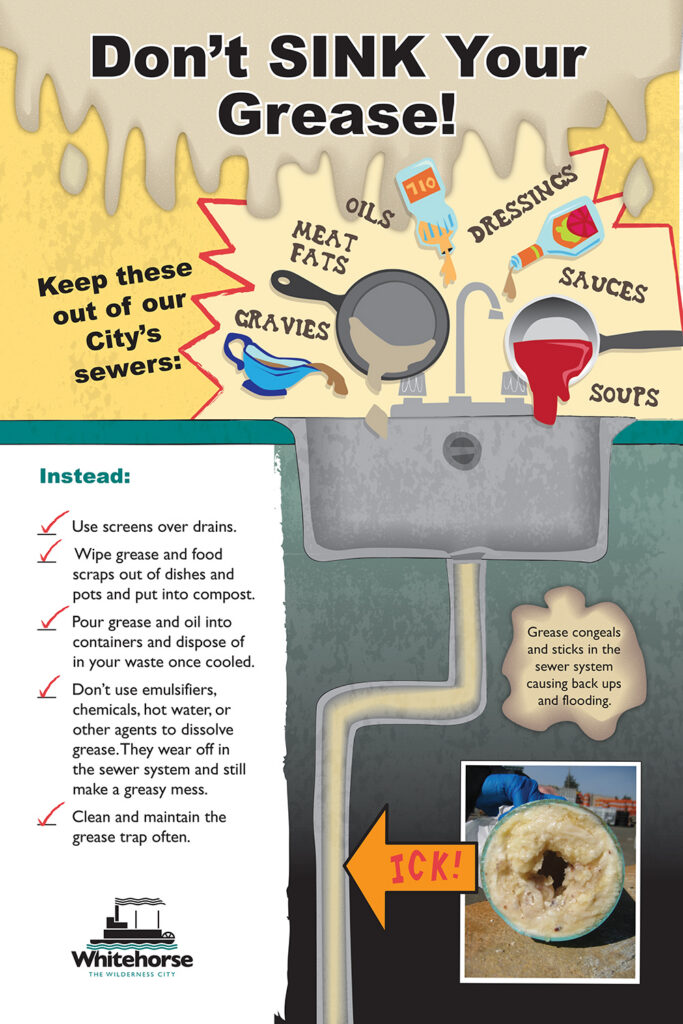

Don’t sink your grease
Where do fats, oils, and grease come from?
The most common sources of household fats, oils, and grease are:
• meats and other food scraps (including baked goods)
• sauces, gravies, and salad dressings
• dairy products (milk, cream, yogurt, kefir, cheese)
• fats, lards, cooking oil, shortening, butter, and margarine
• cosmetics and toiletries (makeup, lotions, some soaps and oils)
How do these blockages affect the sewer system?
You may think that once you flush it, it simply washes away and is gone for good. That’s not the case.
Blockages and plugs lead to problems such as:
• Raw sewage overflowing and backing up into your home, business, or a neighbouring property.
• Basement flooding (an expensive and unpleasant situation).
• Increasing operations and maintenance costs to clean and repair damaged sewer pipes.
What should you do with your fats, oils and grease?
• Let the grease cool and harden, then scrape it and food scraps from trays, plates, pots and pans, utensils, grills, and cooking surfaces into your Green Cart.
• Small volumes of liquid cooking oil can be placed into the Green Cart as long as the oil can be absorbed by the other organic materials or paper towels.
• Larger amounts should be collected into a sealed container labelled “cooking oil” which can be dropped off on Saturdays at Household Hazardous Waste. whitehorse.ca/hhw
Businesses in the food industry
The City of Whitehorse Sewer and Storm Bylaw requires all commercial, industrial, and institutional food facilities to dispose of fats, oils, and grease properly, and to install and maintain a proper grease interceptor (grease trap) to appropriate plumbing fixtures.
Click on image for a printable PDF.