




Country Residential
Country residential properties are required to manage their own waste in accordance with the Waste Management Bylaw. This includes sorting waste properly and ensuring that waste does not harbour or attract wildlife.
Garbage
The City does not provide garbage collection services to country residential properties. They are required to handle their garbage using private waste collection services or by self-hauling to the Waste Management Facility.
Organic Waste
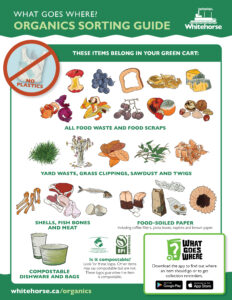
Organic waste is not allowed in your regular garbage. Organics can be brought to the Waste Management Facility for disposal.
Backyard composting is permitted in country residential areas, but residents must adhere to the following requirements:
- Composting is not permitted on public lands
- Meat, fish, and pet feces are not permitted in backyard composters
- Backyard compost may not be sold
It is strongly recommended to use a bear-proof container or put up fencing to prevent wildlife accessing backyard composters. All residents are responsible for ensuring that their waste does not harbour or attract wildlife.
For more information on managing wildlife attractants, click here.
Recycling
Recycling collection for country residential properties can be organized through a private service provider, or packaging and paper products can be self-hauled to Raven ReCentre for free drop-off.
Residential Drop-Off: Monday – Saturday, 9 am – 5 pm
For information or questions on residential recycling in Whitehorse, visit Circular Materials.
Organic and non-organic waste can attract unwanted wildlife (e.g., bears, foxes, etc.) to your property. Keep waste locked up inside a building will deter wildlife. Storing any waste – especially organic waste outside is a wildlife attractant. If you are using private collection, ask your service provider to provide a wildlife-resistant container.
One way to reduce your self-haul waste is by having a backyard compost. A backyard compost is a wildlife attractant; therefore, steps need to be taken to deter wildlife.
- Use a bear proof backyard composter
- Add brown materials (e.g., leaves) to reduce smell of food waste
- Do not include meat, fish or pet feces
- Add an electric fence around compost and other wildlife attractants (e.g., fruit tree, berry bushes, vegetable gardens, or chicken coops).
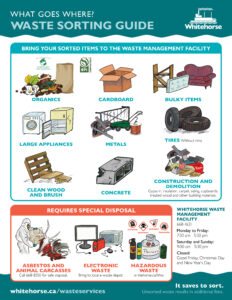
You are required to sort organics, metals, clean wood, appliances, tires, concrete, asbestos, animal carcasses and hazardous waste. Recyclable packaging and paper products, cardboard and electronic waste are not accepted at the Waste Management Facility and should be brought to Raven ReCentre for free drop-off.
Want to learn what goes where? Check out our Waste and Organics Sorting Guides in English, French, German, Northern Tutchone, Southern Tutchone, Tagalog, and Punjabi. Click and print copies for your home and office.
Why sort waste?
Sorting your waste reduces the cost of disposal and helps conserve landfill airspace. Unsorted waste is subject to higher tipping fees. When materials are separated, we create opportunities for recycling and composting. Diverting organics to our compost facility reduces greenhouse gas emissions from the landfill.
You are required to sort certain wastes such as organics, metals, clean wood, appliances, tires, concrete, asbestos, animal carcasses, and hazardous waste. Recyclable packaging and paper products, cardboard and electronic waste are not accepted at the and should be brought to Raven ReCentre for free drop-off.
Some waste requires special handling for safe and effective burial in the landfill, such as animal carcasses and asbestos.
Our What Goes Where app makes sorting your waste a snap. Click on ‘Wizard’ to search for an item and we’ll give you local options for recycling, composting, or disposal. If you can’t find a given item, e-mail [email protected] with your inquiry.